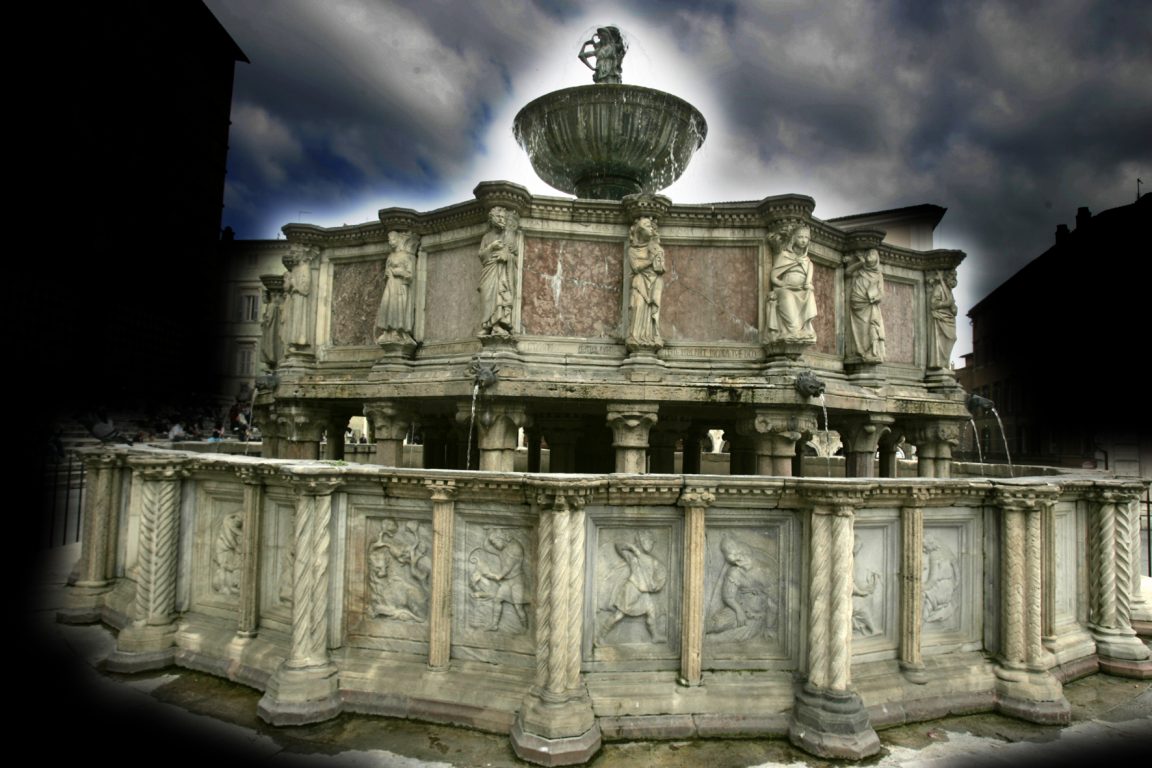
The reliefs and inscriptions that decorate the Main Fountain of Perugia catch the eye of every passer-by. In the past the reliefs of the fountain welcomed the merchants for the fair, consoled the farmers worried about the next harvest, and made all quietly reflect, whether they be man or woman, elderly or young.
Much has already been said on the artistic and symbolic significance of this important medieval monument, except for one aspect that until today has never been considered: the Fontana Maggiore is above all Woman.
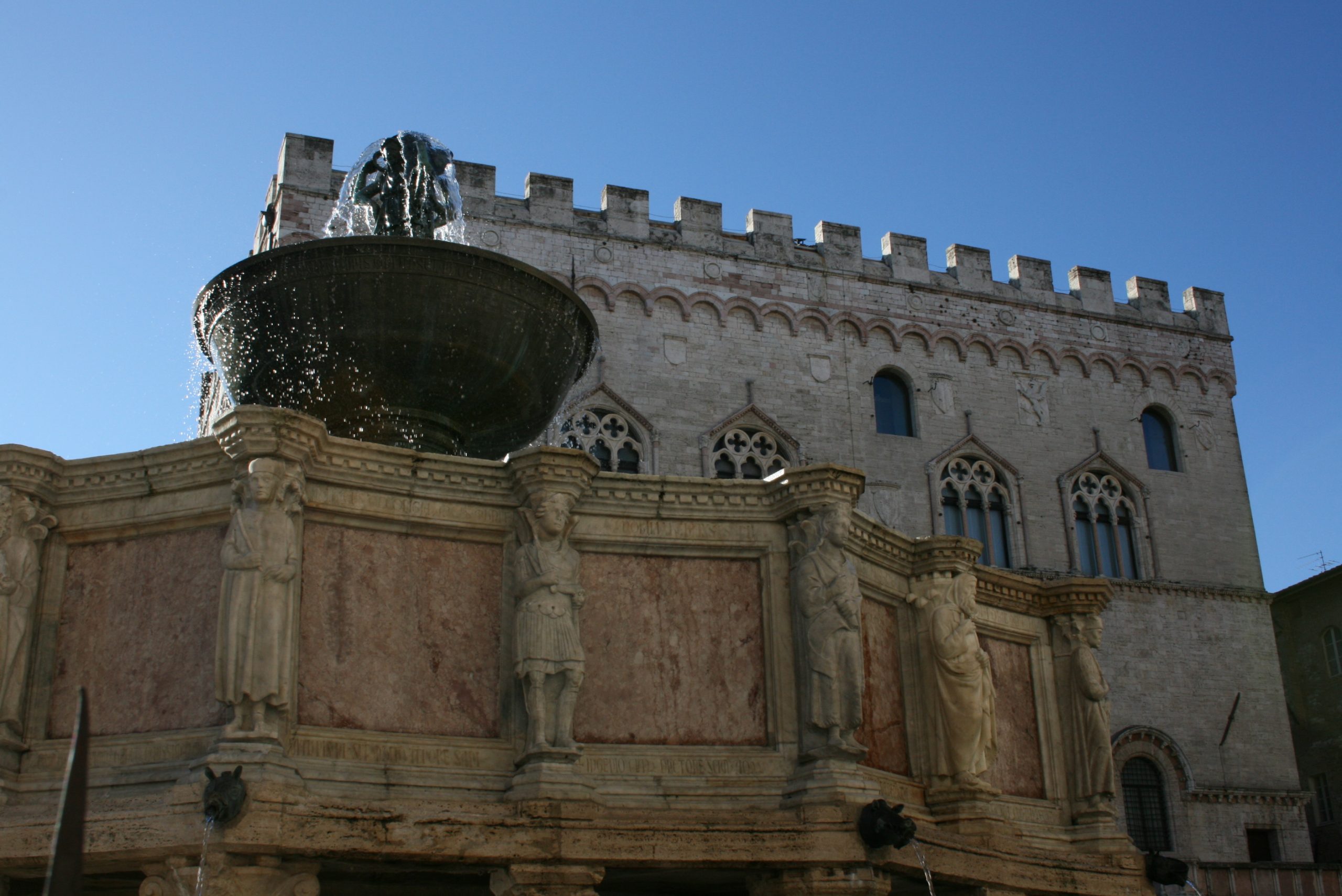
Along with the many female figures carved by Giovanni and Nicola Pisano, we find women representing allegories such as the Victoria Magna , the Roman Church, the Theology, and Rom, represented in the upper basin as a matron seated on a throne, above the reliefs that in the lower basin tell us the story of the mythical founding of the city by Romulus and Remus. Among the mythological subjects we find the legendary She-wolf of Rome, portrayed milking the twin brothers, and Rea Silvia, the vestal virgin depicted holding a cage, maybe a symbol of the container in which the sacred fire was kept burning in honor of Vesta.
The memory of the Roman Calendar still seems alive in the 13th century, even though it may seem difficult to grasp how well the commissioners knew of the connection between the cycle of the months in the Middle Ages and the ancient religious Roman calender
The personification of the town of Perugia, in the upper basin, is depicted too as a matron: she’s holding a cornucopia, symbol of abundance, fertility and fortune. The lady of Perugia is flanked on either side by two female figures representing the territories under her control: to the left is the Lady from Chiusi, in the act of offering grain to Perugia, while to the right is the representation of the Lake Trasimeno, carved in the act of offering fishes to the Guelph Perugian Commune.
The Liberal Arts, from Grammar to Dialectics and from Geometry to Music are represented by women, as well as Philosophy and Astronomy, together donning crowns on their heads to underline their importance as the highest respected sciences between the Liberal Arts.
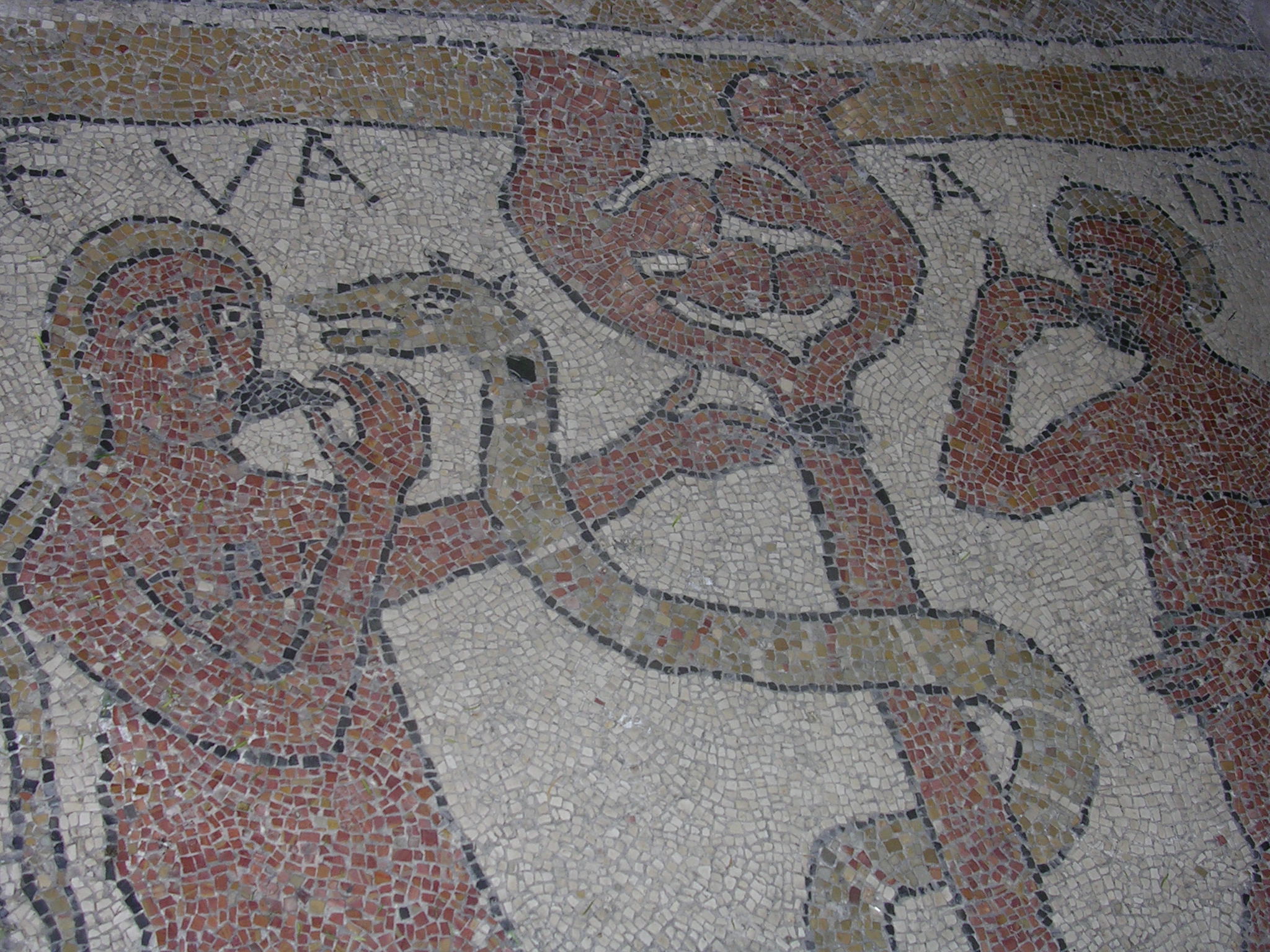
In the lower basin of the Main Fountain some of the most familiar feminine characters from the Bible remind us of the moral view of the Benedictine Abbot Geoffrey of Vendome, who said: “this sex has poisoned our first born, has strangled John the Baptist, and has brought on the death of the courageous Samson”. Those three responsible culprits: Eve, Salome and Delilah (mulieres perniciosae) are all present on the reliefs of the fountain.“
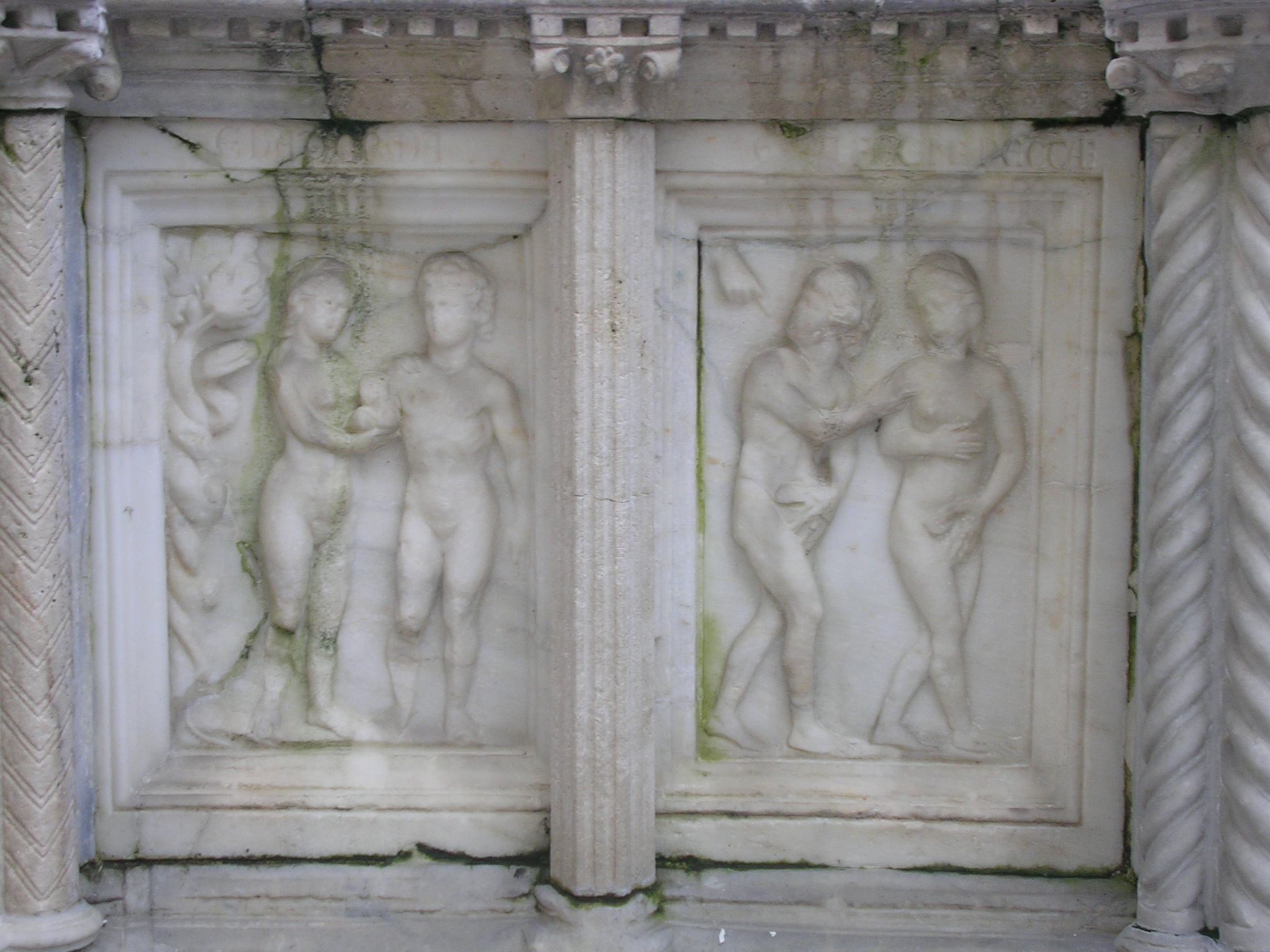
One can read Eva fecit me peccare in the inscription that runs above the scene of the expulsion from Eden. It is Adam, of course, who spits out these words as he accuses her of making him sin. Immediately after follows the scene of Delilah, shown in the act of cutting Samson’s hair, thus depriving him of his power and authority.
On the higher basin we are then presented with the character of Salome who holds the head of John the Baptist in her hands. However, according to some this may in fact be a depiction of Judith rather than Herod’s diabolical dancer. Judith, the beautiful Hebrew widow who cut off the head of her people’s nemesis Holofernes. Even still, a woman courageous and tremendous who was able to obtain what she wanted through the weapon of trickery and seduction.
Antonella Bazzoli, June 2009
Contrary to the common stereotype and this presentation of women to fear, the medieval woman was well integrated in communal life and once married she enjoyed the esteem of being the fulcrum of the household and many social activities. This integration however has not to be interpreted as the emancipation of the woman in the middle ages. Even though the wife (uxor) played some social and public roles in the family and in the community, she was still always seen as weak in nature and needy of protection.